
Safety Systems
ADAS Calibration
After a windshield replacement, the safety cameras and sensors mounted to your glass must be recalibrated. We restore every ADAS feature to manufacturer specs — so your vehicle protects you the way it was designed to.
What Is ADAS?
Advanced Driver Assistance Systems
ADAS is an umbrella term for the suite of electronic safety features in modern vehicles. Most are powered by a forward-facing camera mounted directly to — or behind — the windshield. When the glass is removed and replaced, that camera's angle changes, even slightly. A misaligned camera can cause the system to misjudge distances, fail to recognize lane markings, or not respond to a vehicle stopped ahead.
Automatic Emergency Braking (AEB)
Detects obstacles and brakes automatically when a collision is imminent. Miscalibration means it may not respond — or may brake unexpectedly.
Lane-Keep Assist (LKA)
Reads lane markings and corrects steering drift. Requires precise camera alignment to identify lane lines at speed.
Adaptive Cruise Control (ACC)
Maintains a set following distance using radar or camera data. Must be calibrated to correctly judge the distance to the vehicle ahead.
Forward-Collision Warning (FCW)
Audible and visual alert when closing speed on a vehicle ahead is too high. Camera angle affects detection range and timing.
Traffic Sign Recognition
Reads speed limit and road sign information. Depends on a correctly aligned camera to read signs reliably at highway speeds.
Blind-Spot Monitoring
Radar-based detection of vehicles in adjacent lanes. Sensors may require recalibration if mounted near the replaced glass or disturbed during installation.
Calibration Methods
Static vs. Dynamic Calibration
Static Calibration
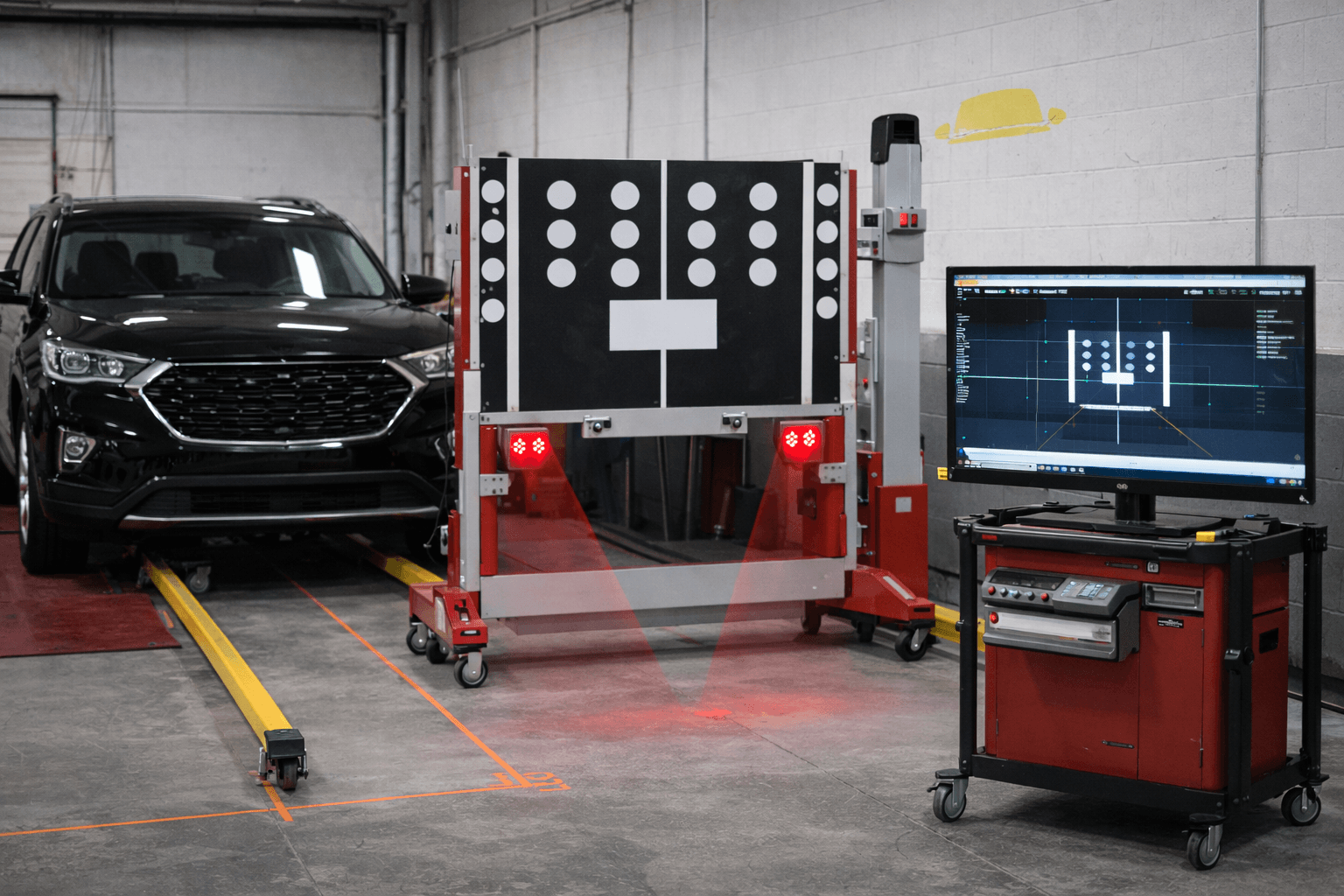
Performed inside our Fort Collins shop using OEM target boards placed at manufacturer-specified distances and heights in front of the vehicle. Diagnostic equipment reads the camera's output and adjusts until all values are within tolerance.
- Vehicle parked in a controlled environment
- Target boards at precise distances
- Requires level floor and controlled lighting
- No driving required
- ~45–90 minutes
Dynamic Calibration
Performed while driving at highway speeds on a road with clear lane markings. The camera calibrates itself using real-world road data while a technician monitors the diagnostic tool to confirm successful completion.
- Requires visible lane markings on open road
- Driven at specified speeds (typically 35–65 mph)
- Technician monitors calibration status in real time
- Some vehicles require both static and dynamic
- ~20–30 minute drive after static setup
The calibration method required for your vehicle is determined by the manufacturer. We look up the specification for your exact make, model, and year before beginning.
Bundle & Save
Replacement + Calibration in One Visit
Schedule your windshield replacement and ADAS calibration together and leave with everything working correctly — in a single shop visit. We coordinate with your insurance to include calibration in the claim when required.
Learn about Windshield ReplacementFAQ
ADAS Calibration Questions
What happens if I don't recalibrate my ADAS after a windshield replacement?
An uncalibrated camera can misread lane lines, fail to detect vehicles ahead, or issue false alerts. In the worst case, automatic emergency braking may not activate in time — or may activate when it shouldn't. Proper recalibration is a safety requirement, not an optional upgrade.
How do I know if my car has ADAS features?
Most vehicles built after 2018 include at least one ADAS feature. Common indicators: lane-keep assist, automatic emergency braking, adaptive cruise control, blind-spot monitoring, or a forward-facing camera mounted to the windshield near the rearview mirror. Your owner's manual or our technician can confirm during the inspection.
What's the difference between static and dynamic calibration?
Static calibration is performed in a controlled shop environment using target boards at specific distances and angles. Dynamic calibration is performed while driving at highway speeds on a road with visible lane markings. Some vehicles require both. We'll determine the correct method for your specific make and model.
Does my insurance cover ADAS calibration?
Yes — ADAS calibration is typically included in a comprehensive insurance claim when it's required as part of a windshield replacement. We'll document the need and include it in the claim paperwork we file on your behalf.
How long does ADAS calibration take?
Static calibration typically takes 45–90 minutes in our shop. Dynamic calibration requires a 20–30 minute test drive after setup. If your vehicle requires both, plan for approximately 2 hours total.
Can I drive my car before ADAS calibration after a windshield replacement?
You can drive the vehicle once the adhesive has cured (usually 60 minutes after installation), but your ADAS features may be disabled or unreliable until calibrated. We recommend scheduling calibration the same day as your replacement whenever possible.
Don't Drive on a Miscalibrated Safety System
Fort Collins shop. All major makes and models. Insurance-covered when part of a replacement.
Other Services